

Research Note
A family may need to move between an organization page, a seasonal brochure, an online registration system, and a social update before it can answer basic questions. Who is the program for? When does it run? What does it cost? Is registration open? Is the published information still current?
CI-Digital conducted a desk review of a selected, non-exhaustive set of publicly accessible program and registration pages covering several service models in and around Charlottetown, with some province-wide examples. The purpose was not to rank providers, recommend a program, or observe actual family behaviour. It was to examine how information is presented, where the decision path may become fragmented, and what local organizations can do to make their public information easier to use.
Main finding
The main finding: public visibility and decision readiness are different
A program can be visible online without being ready for a family to evaluate. A general page may explain the provider and the type of service. A seasonal brochure may list dates and fees. A registration portal may show the current program card. A separate information package may explain equipment, pickup, or participation requirements.
Each source can be accurate while still leaving the reader to assemble the answer.
The City of Charlottetown, for example, publishes a seasonal recreation brochure and links separately to online program registration. UPEI's Panther Academy page explains its age range and school-year services, then directs families to a separate recreation portal for current youth programming. STEAM PEI presents several program types on its main site and uses separate booking or registration paths for particular offerings. In each case, program discovery and action are handled across more than one public surface, so the transition between them needs to be clear.
For a family, the practical question is not simply, "Does this organization offer something for children?" It is, "Can I tell whether the current offering fits before I begin registration or make an inquiry?"
Information surfaces
Five public information surfaces do different jobs
For this note, CI-Digital groups relevant public information surfaces into five useful categories. They can work together, but they are not interchangeable.
| Information surface | What it does well | What the reader may still need |
|---|---|---|
| Organization or program overview | Explains the provider, purpose, audience, and broad service model | Current dates, fees, availability, and direct next step |
| Seasonal brochure or program guide | Brings many offerings into one dated document | Changes made after publication and live registration status |
| Dynamic course or registration catalog | Shows selectable programs, transaction details, and sometimes deadlines | A simpler way to understand which option is relevant before opening an account or checkout flow |
| Referral or eligibility page | Explains who the service is designed for and how access works | Whether the reader can act directly or must begin through a school, professional, or partner organization |
| Social post, newsletter, or announcement | Draws attention to an opening, deadline, change, or event | A stable page containing the complete and current program details |
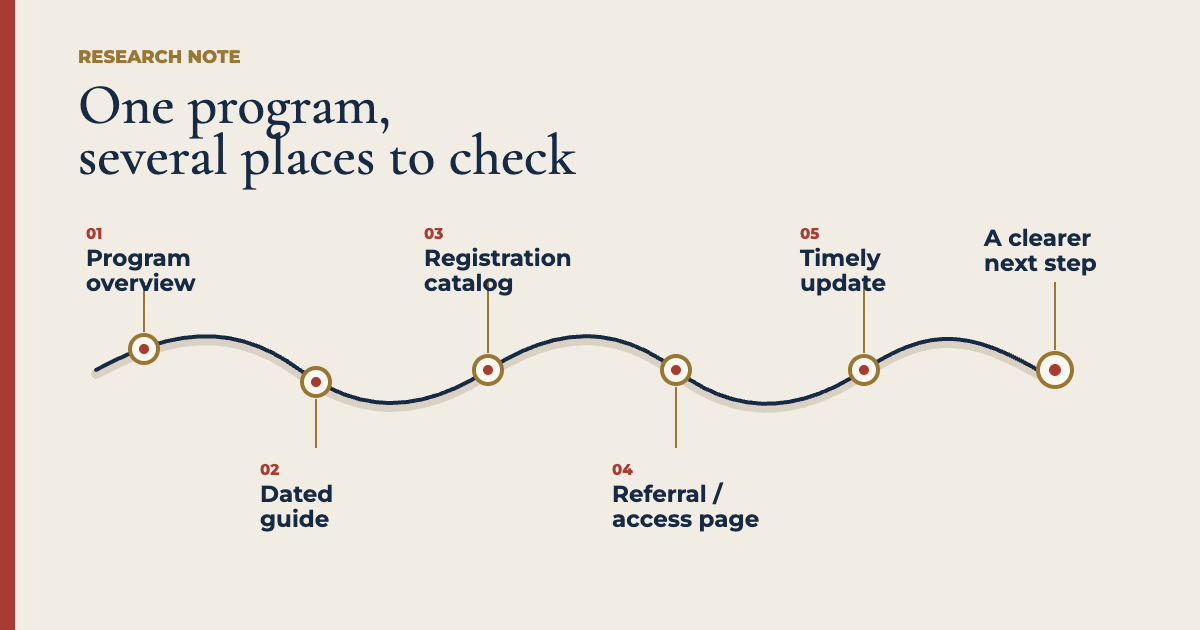
CI-Digital's recommended content model does not force one channel to perform every job. It uses a stable page for the core explanation, a current registration system for the transaction, and social or email updates for timely changes. This is an editorial recommendation, not a measured finding about registration performance.
Decision details
Families need more than a program name and age range
Age or grade fit is important, but it is only one part of the decision. A useful public description should make the following information easy to find:
- age, grade, experience level, or other participation requirements;
- specific dates, frequency, and start and end times;
- location and whether the location changes;
- price, required membership, equipment, subsidy, or additional fees;
- program format, including whether it is a class, camp, drop-in, recurring care arrangement, referral service, or one-time event;
- registration route, opening date, deadline, waitlist, or referral process;
- what a family should expect before the first session;
- the date on which the information was last reviewed or updated.
Different programs will need different details. A public makerspace service, for example, may need to explain file formats, staff operation, materials, and collection procedures. A learn-to-skate program may need to explain equipment, annual membership fees, supervision, and skill level. A literacy program may need to explain that access begins through a school referral rather than a public registration button.
The point is not to make every page longer. It is to publish the information that changes whether a reader can decide what to do next.
Current information
A current date is part of the service information
Children's programs are highly time-sensitive. Seasons change, locations move, registration opens and closes, age groups shift, and a familiar program may not return in the same form.
The review identified pages displaying dated program information or concrete operating details. The City of Charlottetown identifies its 2026-2027 fall, winter, and spring brochure. Publicly indexed Sherwood Parkdale Skating Club program information illustrates fields such as dates, times, locations, fees, registration windows, and additional fee conditions. The Government of Prince Edward Island's library technology page provides operating information for the Charlottetown Library Learning Centre Makerspace and its staff-operated 3D-printing request service.
Displayed dates and fields do not independently establish accuracy, complete cost, eligibility, current capacity, or live availability. No registration transaction was tested as part of this review.
It also found why a date alone is not enough. A navigation label, archived schedule, or older program guide can remain online after a newer season begins. A page can describe a recurring service accurately while its current intake or registration status remains unclear. The safest public pattern is to identify the season or review date on the page and link directly to the current registration or access route.
For providers, maintaining dates is not merely website housekeeping. It is a customer-service function.
Access models
Not every useful resource is a conventional class
The public landscape includes several different access models.
UPEI Panther Academy describes after-school care, professional-development-day programming, March Break programming, and selected sport programs, although the overview does not by itself confirm current intake. STEAM PEI lists camps, after-school workshops, in-school programs, community events, and makerspace-related experiences whose availability varies by offering. The Charlottetown Library Learning Centre describes makerspace access and a staff-operated 3D-print request service rather than a single fixed children's course. The PEI Literacy Alliance's Ready Set Learn page describes school referral and one-to-one summer tutoring rather than open public enrollment.
These differences matter. A directory that treats every resource as a simple "program" can hide the actual access route. Families may be comparing:
- full-day care and short enrichment;
- recurring instruction and a one-time event;
- open registration and referral-based support;
- a coached program and access to equipment or facilities;
- a stable seasonal schedule and an announcement-driven opportunity.
Useful public information should make the service model visible before asking the reader to register, email, or create an account.
Coordination
Small-market information has a coordination problem
In a smaller market, a provider may rely on a modest website, a third-party registration platform, a PDF, and social media at the same time. That can be efficient for the organization, but it creates a coordination problem when the sources do not clearly point to one another or do not share the same date.
CI-Digital interprets fragmented public information as a potential source of repeated questions and decision uncertainty. This public-source review did not measure inquiry volume, registration completion, content reuse, or business outcomes.
Local organizations do not necessarily need a more complex website. They need a clearer information structure:
- one stable page that explains the program and who it is for;
- one current source for dates, fees, and registration status;
- direct links between the explanation and the action;
- dated social updates for openings, changes, and deadlines;
- a simple method for retiring or labelling old information.
As a recommended content model, this structure can also support reuse. The website holds the complete answer. A Facebook post can highlight a deadline or new session. An email can point to the same current details instead of rewriting them. This potential benefit was not measured in the review.
Structured tools
Keeping changing information manageable
Structured tools can help an organization compare program pages over time, identify changed dates, group offerings by category, normalize fields such as age and price, and flag missing information. That can be useful when details are spread across websites, PDFs, registration catalogs, and announcements.
These tools do not establish a child's personal fit, a family's schedule, the quality of instruction, unpublished capacity, or whether a provider will make an exception. Silence on a page is not proof that a program is unavailable. Current sources still need to be checked before the information is used.
For CI-Digital, technology is useful when it makes public information easier to organize and compare. The value is the clearer picture and the practical next step, not the tool itself.
Provider checklist
A practical public-information checklist for providers
Before promoting a children's program, a provider can test its public material with ten questions:
- Is the current season or year visible?
- Can the reader identify the intended age, grade, or skill level?
- Are the start date, end date, frequency, and exact times stated?
- Is the location clear, including any date-specific changes?
- Are the fee and common additional costs explained?
- Is the format clear: camp, class, care, drop-in, event, or referral service?
- Does the page explain whether registration is open, closed, waitlisted, or handled through another organization?
- Does the registration link lead to the relevant current item rather than a general portal?
- Are equipment, supervision, pickup, or first-session expectations explained where they matter?
- Is there a review date and a clear contact route for questions the page cannot answer?
This checklist does not require every detail to appear in every social post. It requires the complete answer to exist somewhere stable and current.
Local organizations
What this means for local organizations
The public sources reviewed show a varied children's learning and activity landscape, including municipal recreation, university programming, literacy support, sport organizations, STEAM programs, libraries, and community activities.
The opportunity is to make those resources easier to evaluate. A provider can improve the customer experience by reducing the number of places a family must check, showing which information is current, and giving each public channel a defined job.
For organizations planning a website, registration change, or content update, the starting point is not necessarily more promotion. It is a review of the questions a family must answer before it can decide.
Sources and limitations
Sources, interpretation, and limitations
Public sources reviewed on 18 September 2026 included:
- City of Charlottetown, 2026-2027 Fall, Winter and Spring Program Brochure and Online Program Registration.
- University of Prince Edward Island, Panther Academy.
- PEI Literacy Alliance, Ready Set Learn.
- STEAM PEI, Programs and Services.
- Government of Prince Edward Island, Technology at the Library.
- Tennis PEI, Youth Programs.
- Sherwood Parkdale Skating Club, Program Registrations.
This is a selected public-source snapshot, not a systematic census of PEI children's services. No provider was contacted, and no registration, transaction, enrollment, capacity, or availability test was performed. It does not assess instructional quality, child safety, provider compliance, program outcomes, or personal suitability. Program details and registration status can change; retained time-sensitive facts should be rechecked before publication, and readers should verify current information with the provider before acting.
Organizations named in this note are cited solely as public information sources and examples. Inclusion does not indicate endorsement, partnership, client status, approved-provider status, or verification by CI-Digital.
Observations about information structure, channel roles, decision readiness, and AI-assisted monitoring are CI-Digital analysis. No private child or family information or client material was used in this note.
References to structured tools describe potential research uses, not a product or performance claim.
View related services.