
Context
This note separates source findings from CI-Digital interpretation. The reported figures and platform descriptions come from the sources listed below. The observations about workflow, channel roles and marketing decisions are CI-Digital analysis.
Executive takeaway
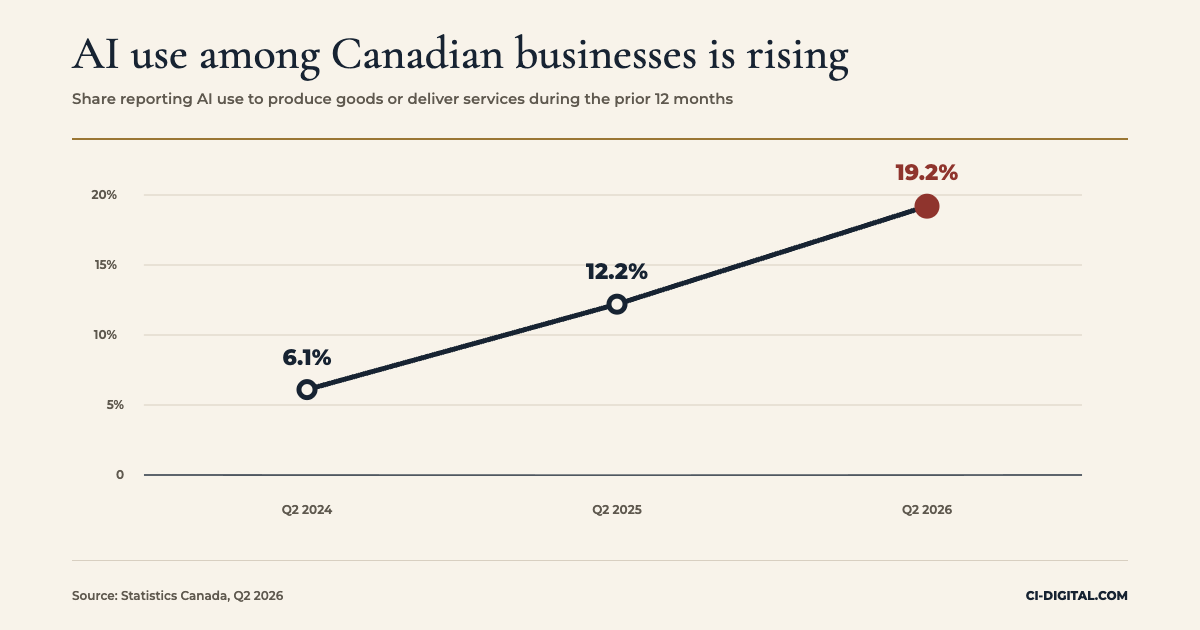
Statistics Canada reported that 19.2% of Canadian businesses used artificial intelligence to produce goods or deliver services during the previous 12 months in the second quarter of 2026. That was up from 12.2% a year earlier and 6.1% in the second quarter of 2024.
Among businesses already using AI, the leading applications were data analytics (36.6%), text analytics (34.5%), and virtual agents or chatbots (28.2%). These figures describe AI-using businesses, rather than all Canadian businesses. They point to familiar activities: comparing information, working through text and helping with recurring interactions.
CIRA's 2025 Canadian Internet Trends survey reported use of Facebook, YouTube and Instagram by 66%, 55% and 45% of Canadian respondents respectively. Reach alone cannot show what a customer needs to know next or whether a post supports a business decision.
CI-Digital's interpretation is that the three dimensions belong together. As some research and drafting tasks become quicker, the value of accurate information, market context and purposeful channel roles increases.
Market
A real signal, with different starting points
The national rise in AI use is significant, yet it is not a universal instruction. Statistics Canada found different adoption levels across sectors and locations: 42.3% in information and cultural industries, 40.4% in finance and insurance, and 32.4% in professional, scientific and technical services. The reported rate was 21.0% among urban businesses and 9.9% among rural businesses.
Forty per cent of businesses said AI was not relevant to the goods or services they provide. That result matters as much as the overall growth figure. Relevance depends on the customer, the task under consideration, the information available and the effort required to change a working process.
The same reasoning applies to marketing. A large audience may not be the best place for a particular message, and a growing market may not be ready for a particular offer. National indicators set context; a business still needs to look at its audience, alternatives, local conditions and information gaps.
For a local business or a company exploring Canada, begin with a market question: what are customers comparing, what information is missing, and what would make the next decision easier? That establishes whether research, content or a public channel has a useful job.
AI
Workflow support before strategy
The most common uses in the Statistics Canada survey suggest that AI often enters through workflow: sorting information, identifying patterns, preparing an initial response or creating a first draft. Marketing automation fits the same broader process when it helps organize a campaign or prepare material for review.
For example, AI may group recurring customer questions, compare public competitor information, flag inconsistent website wording, or adapt an approved research finding into several formats. A person still needs to check the sources, confirm business facts, decide what matters and approve the public statement.
Of businesses reporting AI use, 44.4% said they had changed training or staffing practices. A dependable workflow has an owner who knows what a useful result looks like and can identify an incomplete or inaccurate one.
CI-Digital's analysis is that easier production raises the value of context. When more businesses can prepare drafts and variations quickly, volume is less distinctive. Accurate service information, local knowledge, relevant examples and a meaningful next step carry more weight.
Social and public channels
Give each one a job
Facebook describes Pages as a place for businesses and organizations to share updates and connect with people. Its Page Insights can report measures such as reach and engagement. Google Business Profile can maintain information including location, hours, website, photos, reviews, posts and selected social links. The website can hold a fuller explanation, sources, service details and the inquiry route.
These channels work better as a system. A Facebook post can introduce an observation, event or research question. A Google Business Profile can support local discovery and dependable business information. The website can provide the evidence and next step. Relevant secondary channels—such as Instagram, LinkedIn or YouTube—can serve different audiences or formats when the material warrants it.
Customer questions and channel response can reveal recurring confusion or interest. They can inform the next content or research question, but they do not replace market validation. Repeating one automatically adapted paragraph everywhere may increase activity without helping a customer compare, trust or inquire.
Decision matrix
A Market-AI-Social decision matrix
| Business situation | Market evidence needed | AI may assist with | Public-channel use | A person verifies |
|---|---|---|---|---|
| Evaluating a new market | Customer groups, alternatives, local expectations and information gaps | Compare public sources and organize differences | Website research note or market-entry page | Source quality, geography, assumptions and conclusion |
| Improving website information | Repeated inquiries, service changes and competitor presentation | Flag repeated or inconsistent wording and possible gaps | Website and Google Business Profile | Actual services, priority, location details and public claims |
| Maintaining social content | Approved research, company events and customer questions | Group themes and prepare format variations | Facebook, Instagram, LinkedIn or YouTube according to audience and material | Relevance, tone, facts, rights and final copy |
| Reviewing customer questions | Non-sensitive inquiry themes and recurring points of confusion | Cluster questions and prepare an initial FAQ structure | Website FAQ, service page or follow-up social post | Privacy, missing context and the answer provided |
| Learning from published content | Aggregated reach, engagement, clicks and inquiry patterns where available | Summarize patterns across reporting periods | Internal review leading to the next website or social decision | Data limits, causation, business significance and next test |
The sequence matters more than the software:
Market question -> evidence -> AI-supported task -> channel role -> human review -> feedback
Starting with the market question makes it possible to see whether the process improved a decision, a customer communication or neither.
Bounded test
Start with one bounded test
A two-week test offers a simple way to learn whether a particular use is worth continuing. Choose one recurring task with a defined input and use only non-sensitive information. Record the time required before and after assistance, the corrections or missing context found during review, and whether the output helped a real decision or customer communication.
Begin away from the highest-risk material and avoid an automatic public response. If checking the output takes longer than doing the original task, that is still useful evidence: the workflow needs a different use case, more reliable input or a different approach. At the end of two weeks, decide whether the process should continue, change or stop.
Sources and limitations
Sources, interpretation and limitations
Sources reviewed on 5 August 2026:
- Statistics Canada, Analysis on artificial intelligence use by businesses in Canada, second quarter of 2026, released 11 June 2026.
- CIRA, 2025 Canadian Internet Trends.
- Google Business Profile Help, Get started with Google Business Profile and Manage your social media links.
- Facebook Help Center, Pages and See insights for your Facebook Page posts.
Statistics Canada figures describe reported business activity under its stated survey questions and periods. CIRA figures describe respondents to its 2025 Canadian internet survey. Platform documentation describes available features, not guaranteed reach or performance.
The cross-dimensional conclusions about workflow, channel roles, content abundance, local context and decision quality are CI-Digital analysis. This note is not a market-size forecast, product recommendation or promise of sales, reach, efficiency or successful market entry.
View related services.